June 2005
Monthly Archive
Wed 29 Jun 2005
Chapter Eight
Friend-Less In France
Unless you count my husband, I don’t have any close French friends. I think it is probably because I don’t speak French; kind of hard to be friendly with someone if you don’t speak their language. I can get a few simple ideas across, but once I get passed those I am pretty much out of communication. I also read that most French aren’t looking for new friends - the old ones will do just fine, thank you.
I have an acquaintance who sent me a scathing email, filled with terrible opinions about the French. She said her parents were European and as she stood on a ship leaving for America with them, her father spit into the ocean and said he never wanted to set foot on French soil again. She said I would never have French friends because the French hate Americans and that if I knew what they were saying behind our backs, as she does, I wouldn’t choose to live there. Well, as I don’t speak French and don’t know what they are saying behind my back, I can only go by what is happening in front of me and I feel accepted for the most part. They always give me a smile and like to practice their English with me.
I know my husband’s relatives better than other French and I must say they have never been anything less than kind to me. Maurice’s Aunt and Uncle always extend their hospitality to us with a lovely room to stay in, great meals, and an incredible amount of Champagne when we visit. His children have been great to us. His son likes to tease me and spends a lot of time talking to me in English. He doesn’t beat a path to the door the minute I enter the room. Maurice’s daughter gives me gifts from her designer line, has us over for dinner, listens to me, and talks with me. If I only had them to go by, I would say the French were warm and gracious.
I got talked into leading an English discussion group with some French women, all military wives or nurses. They are all very friendly to me, and I think they liked me, but I have never done one social thing with them. I don’t think it ever occurs to them that I might like to get to know them socially. It has taken me awhile to learn that there are some things you don’t ask in a social setting. The elections were in the process of occurring and I asked them who they voted for: Chirac or the very questionable Le Pen. One of them held up her index finger and moved it back and forth like a metronome, the French sign for “No, no,” and said, “You never ask people a question like that in France.” So I would ask them to talk about something in English like, “Tell me what your favorite dish is to cook,” and then I would slap my hand over my mouth and say, “Can I ask you that?”
I never felt more alone than September 11th. My husband was out of town and called me that afternoon to tell me something bad was happening in the States. I turned on CNN and watched as the second plane crashed into the World Trade Center. It was so horrifying. I didn’t know what to do. I called everyone I could think of in the States and while the news continued on and on in an unbelievable way I talked to my two sons, my mother - I was talking to her when the first tower collapsed - my husband, twice. I just needed the connection of another human being, but especially another American. I hadn’t been in Paris long enough to have any friends. I would walk down the streets the next day, or go into a grocery store and want to yell, “I’m an American!” I’m not sure why.
On my way to my French class two days later I was on the subway seated next to a lady reading the paper with a photo of the towers burning on the front page. I told her I was from the States and I placed my hand over my heart and told her it was so difficult. She just looked at me and didn’t say anything in reply. I don’t know what I wanted her to say, maybe just to agree how awful it was. When I got to my class only two people told me how sorry they were, an Iranian and an Iraqi, ironically two people from countries that are supposed to hate America.
I have often heard the comment, “You live in France and you don’t speak French?” The comment I want to reply with is, “Why? I’m not friends with any French people.” I haven’t said that but sometimes I feel like that.
Maurice has French friends and we often have dinner with them. They can speak some English but it seems to be a struggle. Mostly, I sit there, while everyone chatters away in French, catching a word now and then so I know the general topic, but usually I have to wait for Maurice to stop and give me a quick summary. I really like one of the women and I think she likes me but I don’t know if I will ever be close to her as we can’t have much of a heart-to-heart. I say a few words in French, she says a few in English, we each speak in our own language and we get our main ideas across – often with smiles and looks. She’s fun and funny and very nice, but I don’t know if we will ever have a two or three-hour conversation like I do with my American friends.
Most of my friends here in France have turned out to be other Americans. Being a woman, I need someone to gab with, exchange thoughts and ideas with about living in a foreign country. Not only do you learn interesting facts like where to find certain household supplies, but also where great shops are to buy either American products that you are missing or some fantastic new French product that you will soon learn you can’t live without. You learn how to function, and enjoy such a new environment.
For instance, my white clothing was getting dingier and dingier and I couldn’t find any bleach. For some reason, Maurice was clueless here. I discovered that bleach is called Javel (or eau d’javel) in France so I could get those whites looking bright. And I learned that you can’t find baking soda in a grocery store. It is considered a medication so it has to be bought in a pharmacy. Just little everyday things that are hard to find out on your own, that’s what I need, advice from a pioneer who has been down the track ahead of me.
And thank God for the computer. Who knew that someday I would meet some woman on the streets of Paris that I had never laid eyes on before but who I had corresponded with on the Internet? I never dreamed I would make friends this way.
Sometimes, a posting on a travel board catches your eye and you start a little correspondence; you like the way they think. And then you find they are going to be in Paris and you decide to meet. You have to get a description, sort of like a blind date. One friend I met this way has a very flamboyant way of writing and has a gypsy relative in her background. I pictured her as being tall, thin, and with flowing black hair. She turned out to be short and blond. We “clicked” right away. Maybe it’s just that people who love France, and in particular, Paris, are delightful, fun people but I have met a great group of women from America and we have a blast exploring Paris and trying new cafés or shopping in the markets.
One very special friend I met via the Internet who, although she is an American citizen, is Belgian and speaks French. She and her husband live in Paris part of the time and when she is here she takes the time to give me French lessons. How nice is that? She knows a lot about Paris and loves to walk around the city and we often set off exploring and seeing what we can find and taking photos as both of us love photography.
I have also made some friends with other Americans who write for Bonjour Paris, an Internet magazine. We all love Paris, and often get together and exchange ideas and comments about our time here. I don’t know what I would have done without them.
And then there are friends I didn’t know I had who contact me and want a free room to stay in or free tours while here. I think this is often the case if you live in a neat city anywhere. I had an acquaintance that I used to work with that I hadn’t heard from at all once I moved until she decided to visit Paris. It was great to see her and all, but I feel a little offended when I never get notes, letters, or even emails, and then suddenly they want to visit me. Just comes with the territory of living in Paris, I guess.
I have no idea if I will continue to be friendless in France when it comes to French people. Maybe as I learn French this will happen and I try to remain open to it.
Mon 27 Jun 2005
Chapter Seven
Posh-Less In France
Okay. I don’t live in a posh area of Paris. I can’t look out my window and see the Eiffel Tower or the Luxembourg Gardens. I can’t walk out the door and head up the street to Sacre Coeur or turn a corner and be in Place des Vosges. I wish I could, as these are wonderful areas to be in.
I live in the 12th arrondissement, one of the lesser known areas of Paris. When I look out my window I see the apartment building across the street, not a well-known monument. You can learn a lot about people just by looking in their windows. It’s not that I’m a peeping Tom, honest. Sometimes I look out the window to check the sky for clouds or open it to water my pot of geraniums and I glimpse life across the street – or rather, across the inner courtyard if I am at my kitchen window. I haven’t seen any scenes such as those in Rear Window or any amorous clutches.
Across the street is a lady sitting in front of a computer most of the day. I don’t know if she has a small business going or is, perhaps, a writer. One day, she smiled and waved at me as I was working out on my stairmaster in front of the window. One apartment over from her is an older woman I often observe hanging up clothing to dry or ironing. I can also, unintentionally glimpse her dressing or undressing as she never closes her curtains. The lady above her, grows masses of bright red geraniums and picks off dead flower heads every morning and throws them down to the sidewalk, and when she waters, a few unsuspecting pedestrians below get a sudden shower.
If I look across our courtyard which is surrounded on all sides by apartment buildings, I usually see two young men with dark hair looking back at me. I assume they are students as I sometimes see one of them reading a book as the sun streams into their apartment. Of course, for all I know, they could be reading something naughty, which may explain their interest in checking out the view on my side of the courtyard. Maybe a lady above me undresses in front of her window because they always seem to be on the look out for interesting views, and I am very careful to always be fully dressed, especially in my kitchen if I have my curtains open. I am sure they would be shocked if they could see me up close.
There is one apartment that has me worried. The windows are never opened and I thought for awhile that they were covered in some sort of plastic sheeting, but have come to the conclusion that the windows have just never been washed. And I’ve never seen the windows opened, either. Ragged looking curtains hang down and at night, when the interior lights are on, I can see someone come close to the window and it is either the husband or wife looking like they must be in their 80’s, if you can guess such a thing from a distance. Oddly, as long as I can see movement over there every day, I assume they are all right, and breathe a little easier.
When it is sunny, and usually on the weekends, windows are thrown open and women can be seen shaking out dust cloths or mops and shining their windows. They also take duvets and place them half way out on the window ledge, I assume to air them out. I would try this, but my window ledges are too dirty to drape my good linens on. Duvets are a whole new thing to me, a type of comforter with a pillowcase-like cover. Duvets make it really easy to make the bed and are nice and toasty in the winter.
The 12th arrondissement has a large area called Nation. This is a so-called square with a huge roundabout where nine streets converge. The center boasts two tall towers, one mounted with a statue of Saint Louis and the other with a statue of King Phillip August. Centuries ago, tolls were taken here as people entered Paris. It was called Throne Place at one time since a throne was placed here in honor of Louis IV and his bride. For a short time it was called The Place of the Overturned Throne during the turbulent days of the French Revolution.
Also, during this time, over a thousand people were executed at this square after those at the Place de Bastille tired of the crowds, blood and smell. A tiny cemetery, Picpus Cemetery, holds the bodies of those poor souls. Lafayette and his wife are also buried here because some of his wife’s relatives died during The Revolution. Every July 4th, a ceremony is held at Lafayette’s tomb and soil from the United States is sprinkled on his grave, one of his last requests, so the tradition continues.
We are also near Bois de Vincennes, a huge lush park where my husband likes to jog. It has several lakes, an immense floral park, a château, and miles of jogging and biking trails. I had no idea, when I first moved to Paris, that this “bois,” or woods, was so close to our apartment. On my first week we started off on our bikes and soon we passed a lake with a little island in the middle, then a little restaurant, and suddenly, there it was, the Château de Vincennes. It has a lot of French history associated with it but in appearance, it seems rather modest to me if compared to such places as Versailles. The first Sunday of every month there is a meeting of a car club and all sorts of models of cars, mostly vintage, gather here and shown by their proud owners.
Parc Floral, right across the way from the château, has great jazz concerts every weekend in the summer months and is full of gigantic bushes of camelias and other flowering plants. There is an enormous playground for children full of interesting play equipment that even has me thinking about taking a ride or climbing. I was surprised at some things such as a climbing tower of ropes about 75 feet in the air. It has some rubber matting under it, but I don’t think it would help much if a child should happen to fall. Americans would never allow something like this in a park. I can only imagine the lawsuits that would result.
Back towards our apartment, at Place de la Nation, we are lucky to have a huge street market every Wednesday and Saturday. Maurice and I go there to buy fresh fruit and vegetables, fish, meat, chicken, seafood, olives, butter, and eggs. We almost always overbuy as everything looks so delicious. It’s really fun to shop here and we plan our menus for the next few days as we walk along and see what looks good. My favorite thing during June and July are the huge mounds of cherries in every stall. The ones I like best are large and heart-shaped and come from Provence. They can be very expensive so we look around and try to find the best price. Maurice loves strawberries, but not just any strawberry. The first to appear look great to me—enormous as strawberries go, and red—but Maurice says no, they are from Spain, and he says that they usually aren’t grown in soil. He will wait for those from France. He was right, of course. They were smaller, less red but incredibly sweet and flavorful.
Maurice is a good cook and loves to try new recipes. I like some of his tried and true ones best. His beef burgundy is wonderful, and I have really come to love his ratatouille. We often get fresh fish or scallops and, if they look good, Maurice will get snails. They come already covered in butter and garlic—ready to cook. I will try one or two but I don’t love them like he does. He buys oysters, too, when in season, and opens them himself with a lot of prying and pressure. He eats them with a mixture of vinegar and shallots. I tried an oyster once in New Orleans. Once was enough for me. I must admit, however, that he won’t try certain things such as anything with bananas or pineapple or tuna fish sandwiches made with mayonnaise. He hates peanut butter as well. I’m sure it has to do with what he ate as he grew up, as it does with me.
We return home on a street called rue du Rendezvous lined with boucheries, boulangeries, grocery stores, fromageries, a fruit and vegetable place, and pâtisseries. One place sells what are surely the best macaroon cookies and chocolate desserts in Paris. I adore this shop. There is also a small store selling prepared food that’s ready to go. Everything always looks so good but, unfortunately, it isn’t cheap. The first time we walked passed I saw a pan heaped with fried potatoes with added pieces of duck, onions, ham and parsley. I’m sure they also had goose fat in them. It looked so fabulous I talked Maurice into buying some. It was in the days when francs where still used in France and I didn’t really figure out how much we were paying. When we got home Maurice said, “Do you know how much these potatoes cost?” I didn’t have a clue. It turned out that we had paid the equivalent of almost ten dollars for potatoes for two people. I must say, however, that these were the best potatoes I have ever had in my life. Every once in awhile, as we walk by, I will see a pan of them in the window again and try to talk Maurice into more of those delectable ten dollar potatoes. I just can’t duplicate them at home.
Finally, before we head up the stairs to our apartment, we must get a baguette. France has the best bread in the world; I don’t know what they do to make it taste so good. You can cross the border and be thirty minutes into Italy and the taste and texture of their bread is entirely different. I’m sure a really hot oven makes the outside so crusty, leaving the inside soft and chewy. I’ve heard the oven must be used for years to make the bread the right consistency.
Maurice is very picky about his bread. Once, when our usual bakery was closed, I bought a baguette that looked good to me. It was the right shape and the right shade of brown on the outside, but Maurice took one bite and said, “This was mass produced.” Just one bite. He was bothered by the texture of the bread inside which seemed to have too many air bubbles, or something. I thought it was all nonsense, but I don’t any more. When our favorite boulangerie is closed and we are forced to buy our bread at a place across the street I can really taste the difference, not only in taste but in consistency. As with many places in Paris, our boulangerie is closed for the whole of August. I can’t tell you how distressing this is to me.
The shop is no more than a couple of dozen steps from our apartment. One day I saw a white truck parked in front with a hose coming from it down into the basement of the boulangerie. At first I thought it might be delivering fuel but as I got closer I saw a white cloud in the air and I smelled the unmistakable odor of flour. I had no idea flour could be delivered in this way. The bakery across the street gets their flour delivered in sacks carried into the kitchen by men.
Bread was the first thing I bought by myself when I moved to Paris. A couple owns our neighborhood boulangerie and the husband is down in the basement toiling in front of the ovens while his wife mans the counter upstairs. I have only seen the baker twice. He had come up the stairs to bring a tray of desserts and he wore shorts with a long white apron over the top that reached his ankles. His wife used to tell me the price of what I was buying and I didn’t have a clue what she was saying so I would just hold out a hand full of change and let her take what she needed. As time went on she wouldn’t do it but would repeat the price until I understood what she was saying and figured out for myself what to give her. We have never exchanged any more than “bonjour” and “au revoir.” When I walk in the door she reaches back behind her to the forest of bread sticking up in holding racks and pulls out the type of baguette we always eat. I now have the exact change ready as I walk in. This is one time I would love to speak French so I could learn her name and a little about her.
There are some grocery stores in our neighborhood that we go to for staples such as toilet paper, drinks and the like. The least expensive store is called Franprix. I get upset when I shop there because I am accustomed to American efficiency and customer service. There can be 50 people in line, stretched back into the aisles blocking access to products—it is a very small building and everything is crammed together making it hard to even pass people in the aisles. In front of the 4 cash registers will be 3 or 4 women who work there but invariably two of them are involved in some sort of busy work that doesn’t involve waiting on customers.
Another curiosity is that all of the people checking out customers get to sit down. I’ve done my share of retail work and remember how my feet ached at the end of the day. What I wouldn’t have given for a chair back then. And when you buy groceries, you have to bag them yourself. The check-out person will grudgingly dole out one plastic bag at a time, as if they cost a fortune. At a discount grocery store called Ed you have to pay for each bag. The bags in Paris are always plastic—no paper bags here.
On Saturday morning, the busiest morning of the week, two or three Franprix employees will have huge carts of canned goods or cleaning supplies blocking the aisles while they stock the shelves. Occasionally, there will be a man sweeping the floors at the same time. It makes me want to pull my hair out but I know the French would be totally mystified at my attitude. It’s just how it is; they’re used to it. I asked Maurice why they couldn’t clean the floors and stock the shelves when the stores were closed, but they don’t want to pay the extra wages to do this. How does America do it? I remember with fondness the 10-15 open check-out lines. The floors gleamed, the shelves were fully stocked. I do miss that.
It is different here. I miss the comfortableness of America some of the time and being able to find a store open late at night or on Sundays. But there are tradeoffs. I have found more charm here and I enjoy the “event” of shopping the markets. Now, if I could just get the recipe for those ten dollar potatoes.
Sat 25 Jun 2005
Posted by Linda under
GeneralNo Comments
.jpg) Sacre Coeur on top of Montmartre
Sacre Coeur on top of Montmartre
A Montmartre Surprise
A family of four scheduled a tour with me. Among their requests of things to see in Paris, was a desire to go to Montmartre, a popular destination for many tourists to Paris. The mother, named Sandra, told me that she wanted to find a particular painter up on top of the hill. I had my doubts that he would still be there as there can be quite a fluctuation in painters. I see many of them almost every time I take visitors up to Place de Tertre as it is a full time job for them. Others are only there for a season or two and then disappear.
Sandra’s story was this: Fifty years before her parents and the young Sandra had visited Paris and on a visit to Montmartre found a painter that they liked. They were looking at his gentle painting of some clowns (not the scary kind with white faces and red noses) pastel in color playing a musical instruments. Sandra’s father wasn’t sure he liked the selection so the artist took them up to his studio going through a door right on the square, up some rickity stairs and showed them some more of his work. They found exactly what they wanted and bought a painting.
Sandra grew up with that painting. Fast forward, 20 years later, and Sandra returned with her husband, Ron, and they went to Montmartre. They found a painting they liked on Place de Tertre, bought it and when they returned home discovered that it was by the same artist of the painting her parents had bought in the same location. It must have spoken to Sandra, been in her subconscious, and she selected one that felt familiar to her.
So, she wanted to find the artist again as her son had grown up with her painting and wanted something similar for himself. I didn’t have much hope but we set off for Montmartre, took the bus up to the top and found the artists in the middle of the square. We walked around them all and didn’t find the artist. By chance, Sandra stopped at a lady selling colorful Eiffel Towers painted in plaid and asked him if she knew the artist. To our surprise the lady said, “Yes, I am very good friends with his daughter. He, however, died about 10 years ago.” I thought that was it but then she said, “The daughter isn’t here today but I have the key to her studio and I know there are some paintings left there by her father. Let me take you there.” To Sandra’s surprise, we went through a door right on the square, up the same rickity stairs that she had gone up so many years before and entered the same studio. Among the daughter’s painting were about 50 left by her father. We looked through all of them and they ended up buying four, after the artist with the plaid Eiffel Towers named Kiki, called the daughter and got the prices. Because they bought four, she gave them a discount. The son selected a Paris landscape, the mother bought three clown paintings, two for herself and one for her sister. We left Montmartre very happy people, amazed at how small the world can be and at how amazing it was that, out of all of the painters up by Sacre Couer, she picked the artist who helped them find the paintings of the artist they had talked about for years. It was a real Montmartre surprise.
Fri 24 Jun 2005
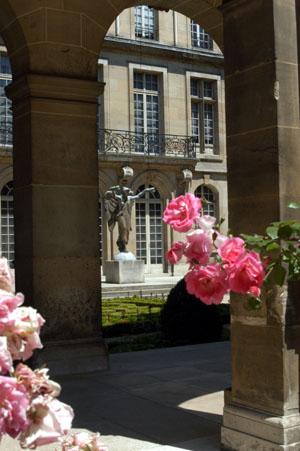
Roses at the Carnavalet Museum in Paris
Back in Paris now and am continuing my Frenchless In France series.
Chapter Six
Water-Less In France
When I was in the States, I lived in New Mexico, Arizona, and Texas through the years. I was used to droughts, water restrictions and the fear that my State would some day run out of water. It used to drive me nuts when I drove through Scottsdale that massive water fountains were being used for landscaping and golf courses were being built with abandon all over the place with green grass stretching as far as the eye could see, yet everyone else was being told to conserve water. I made sure my yard just had desert landscaping and I was religious in following recommended watering schedules.
That is probably why, when I moved to Paris, I was surprised at how the streets were cleaned. Men dressed in a horrible shade of bright green carry green plastic brooms that look like a witch could ride them converge on just about every neighborhood. They sweep away debris that is in the streets into the gutter, where a large amount of water then gushes out and sends it down to the sewer lines. There is even a little piece of folded carpet where the water comes out to head the flow into the right direction.
I honestly couldn’t believe it the first time I saw it. “You mean, this is how they clean the streets? Aren’t they worried about wasting water here? It’s such a huge city, What if they have a drought?” Maurice couldn’t see what I was worried about. It had been done this way for years and, he said, nonpotable water was used, adding, “I don’t know why you think this is so bad. Look how America wastes things such as electricity and gas.” Well, maybe, but you won’t die without either of those. Got to have water.
With all of the street cleaners around, and you do see these men every few blocks, at unexpected hours, you would think the streets would be immaculate. Wrong. Okay, some of them are. Some of them look like they haven’t been touched in months. I seldom see those green guys actually doing any work. They are often on the phone, taking a cigarette or coffee break or laughing with a fellow worker. When they are sweeping, it is done in a rather offhand manner, sweeping here and there. If it gets in the gutter, fine. If the debris is too large to fit down the opening to the sewer, they just leave it there. I’m sure there are eager beavers out there cleaning for all they are worth but I just haven’t seen any. Their busiest time is in the autumn when the leaves start falling. If they don’t keep them swept up, as I saw first-hand once during a street cleaner and garbage collector strike, the run-off drains get clogged and water pools in ponds at every corner and become difficult to jump over.
Once or twice a month an enormous water truck comes down every street with a crane-like bar that goes over cars with a hose attached. As water under high pressure comes out, a man in green with rubber boots moves the hose back and forth getting the more difficult to remove items off the sidewalk. And watch out if you don’t see them first and get in the way: you are in for a drenching. I was told that there was some sort of insect repellent in the water to keep down the flies and I must say that I seldom see a fly in Paris. There are no screens on windows here and if it is not too hot or too cold you leave the windows open. Very seldom does a fly or mosquito enter our place. Maybe they’ve all gone down south.
One thing these high pressured sprayers does is remove the dog poop. Left behind or stepped in, there is a lot of it. The French truly love their dogs. There has been a campaign to get dog owners to start picking up after their canines but it has been slow going. A friend of mine was cleaning up after his and a neighbor came out, hollering, telling him that if he started doing it everyone else would have to! One of the inalienable rights the French feel entitled to is, apparently, not having to clean up their dogs’ droppings, no matter how disgusting the mess left behind. There may be a revolution over this. Millions are spent by the city cleaning up after dog owners. There is even a battalion of cleaners, who I can only hope are being well paid, who ride matching green motorcycles and have a device to vacuum up the dog dung. But even with those, you still have to be careful where you step. Lately, more people are getting their dogs to go against a building, under a tree, or in the gutter, but not always. It’s not fun to watch people doing the old banana peel slide if they aren’t careful where they step.
Special areas for dogs to use have been set up in most parks. It is usually a small, enclosed area with a gate and a picture of a dog to show it’s purpose. There is a very nice area called Place Dauphine with a large area set up like this. The owners of the dogs often sit at a café across the way so their dogs can romp around under their watchful eyes, just like parents of a toddler. The mutts usually run around and then saunter up to the owners just to make sure everything is still all right.
Dogs aren’t the only creatures using the streets as a bathroom. There seem to be a lot of homeless people sleeping on the streets and in the metro stops. I often am walking down the street and see a little puddle against a wall with a trickle of liquid running across the sidewalk. Occasionally, it will be from watering a pot of flowers up above, but usually it is from a dog that has peed against the wall. When I have my grocery cart with wheels, I often will lift it over the trickle because I hate to then carry the soiled cart upstairs. I just imagine all of those germs next to me as I carry it or wheel it into our apartment. Sometimes the puddle is so large I can only assume it is not from a dog, but a human, and somehow, this is even worse to me. There are narrow gutters that line the walls in the metro stops where the cleaning crew sweeps debris, then turns on water to wash it away, as on the streets. The homeless use these gutters to urinate in. I have also seen mothers hold their little boys over these to use.
We have what I call a resident homeless man, whom I privately call Pierre, who has procured an area under an old abandoned railroad track as his home. I think it used to be a storage room. He even has a door that he can lock and has set up large found pieces of wood around the perimeter for privacy. As I pass by, I get a glimpse of a double bed with a fluffy duvet and pillows, a chest of drawers topped with a vase full of plastic flowers, and a chair. In the evenings I hear a radio playing. There doesn’t seem to be any electricity as I never see any lights, and I can’t imagine there would be running water. Pierre is a friendly, talkative fellow, although I haven’t a clue as to what he is saying. He does his drinking as do many homeless, and I have seen him going through garbage looking for useful items. Once we left some of Maurice’s old shirts by his door. Now, I occasionally walk by and see him wearing one. I passed him one day carrying a sack of groceries with a bouquet of roses sticking out of it. I don’t know if they were given to him when a florist decided they were past their prime, or if he picked them in some park. I wonder who they were for. Being French, probably to spruce up his living space.
In the lower numbered arrondissements you usually won’t see any prostitutes openly advertising their availability on the streets. As the arrondissement numbers get higher, such as ours, the 12th, they are seen, especially at night, but there are one or two who stand at a corner near our neighborhood all day long, rain or shine, whatever the temperature. I wish the streets could be “cleaned” of them but the French don’t arrest prostitutes or chase them away. I’m not sure if I think prostitution is necessarily bad, I just don’t want to see it a block from where I live. Sometimes they round up a few and take them in for medical tests but I’ve been told that if a police stops and questions them, they simply say they were waiting for a friend.
A news report on television the other day said that most of the girls are from Eastern Europe and are desperate to make money. So, as I walk by our “neighborhood prostitute” standing there in a mini skirt and boots with four-inch soles and six-inch heels, I wonder about her life, and what must go through her mind because she has to do something like this.
One night Maurice and I were walking home and actually passed a car on a dark street where one of the “girls” was servicing a client. I thought about knocking on the window and yelling at them, but I’m sure some other car would be there again within an hour. In some parks and along highways outside of Paris, many vans parked at the side of the road where men can pull off and hire a prostitute, just like going into a hotel, only quicker, cheaper and more anonymous. Sometimes the prostitute will be sitting under a tree taking the sun on a beach lounger. Just another part of life in France.
As I’ve been in Paris for awhile now, I don’t cringe as much as I used to when I see water pouring down the gutter. I can’t impose my American way of thinking on a government that has done things the way they have been done for hundreds, if not thousands, of years. I may not agree with all that I see, but I sure am never going to be able to change anything. Part of living in a foreign country is becoming more accepting of how things are done even if you don’t agree with them or like them. And so far, the good things have far outweighed the bad.
Wed 22 Jun 2005
Posted by Linda under
GeneralNo Comments
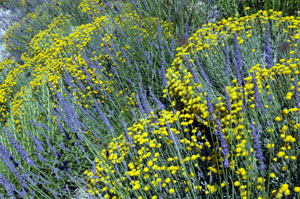
To retain the soil and keep it all from sliding down the hill, we planted a lot of lavender, rosemary and Santalina-which, at first, I thought was going to be thyme. The first year they were all rather puny although the lavender attracted many butterflies. This year everything has really taken off, especially the Santalina which, when held close to your nose, has a pleasant, metallic sort of smell. From a distance, to my nose, not Maurice’s, it smells like dog poop to me. I don’t know what it smells like to all of the flying insects we now attract, but we now have quite an eco-system. I’ve counted 3 different types of bees, a few wasps, the usual flies, and probably 15 or so flying insects that I’m not familiar with. When I stand near the plants, I hear active buzzing going on in that secret little world. I especially love seeing the butterflies, in their short time on the earth, flit from flower to flower, sometimes dancing in the air in circles with a friend. There are small butterflies with lavender wings-could be a moth, not sure-small dark orange butterflies, ones with black wings striped like a hot rod with a white stripe, and there are the usual yellow and orange varieties, but the most common is white with a tiny black dot of the upper part of each wing. One I have just seen this year one that flies in what looks like an upside down manner to me, with its wings larger at the bottom edge. It looks like the shape of a tulip cut in two, and when it lands on a flower, it assumes a flower shape as well, it white wings with black stripes making a pretty sight.
I am especially atuned to butterflies this summer because before my favorite aunt died, she told me she would come again to me in the afterlife in some way having to do with butterflies. I don’t know if it is true or if she has but, every time I sit outside watching our extravaganza of butterflies, I think of my Aunt Lois.
A friend of mine slept in our upstairs bedroom and left the window open at night. She told us that lightning bugs flew in and gave her a light show performance up by her ceiling every night. I haven’t seen any myself here at night. Probably because I am in bed every night before it gets truly dark.
The lavender is just now starting to bloom and it attracts more butterflies than the Santalina-a plant with silvery foliage and yellow flowers. There is a lovely fragrance in the air in the morning with the flowering yellow bushes everywhere, growing wild all over Provence. I have the standard red geraniums doing well. The heat is really settling in now, getting up near 100 in the afternoons.
For the first day of summer, we went into Lourmarin to listen to music, the tradition now in France, and 100 other countries, where music is played all over, late into the night. It is called Fete de la Musique, and it is a great way to welcome in summer.
Sun 19 Jun 2005
Posted by Linda under
General[2] Comments
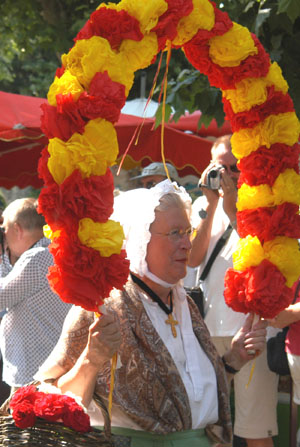
The beginning of the transhumance festival.
Transhumance Festival
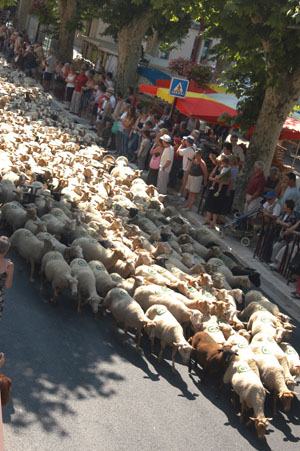
Once a year various animals in France are moved from one area to another, usually in the late spring or early summer. It is called a transhumance which means moving animals from one field to another but it often means moving herds from a lower area to the French Alps. In the case of sheep-there are also transhumance for goats and cattle- this is so they can earn a special label saying they were raised in an area well known for great tasting sheep, rather like Bordeaux wine. You know when you drink it, it has been specially controlled with specific rules and that there is nothing else to compare to it in the world.
In centuries of tradition, sheep, goats and cows have been moved in large herds to the special fields high in the Alps with sweet green grass. Per tradition, the herds are moved along mainly country roads which often happen to pass through villages. A transhumance festival often occurs with people lining up along the side of a village street to watch a herd of sheep moving by like a living, bah-ing river.
One especially fun transhumance to observe is the one taking place in the village of Riez on the edge of the famous lavender country. It is worth visiting Riez just for their fun market set up every weekend selling no vegetables or fruit but Provencal products such as garlic, honey, olive oil and table clothes. At 10:30 the bells of the village church start ringing and then a small procession starts with villagers in native costumes holding arches of flowers over their heads. Drums are beat and small flutes are played. When they reach the end of the street there is a moment of quiet followed by the unmistakable sound of sheep approaching. At the head of the herd is the shepard, the berger, with his dog followed by thousands of sheep each with a painted symbol on their backs of the owner. They move along down the street, not moving into the sidewalks, probably due to their fear of people. At one point, they balked being scared in typical sheep fashion, and the front of the heard circles around on the street for a while until sorted out by two men and several dogs before they moved on to their first field of grass and some water by four Roman columns left from centuries past when Rome had a little village here.
A little glimpse into times past and another fun way to visit little villages in France and experience their festivals.
Fri 17 Jun 2005
Posted by Linda under
GeneralNo Comments
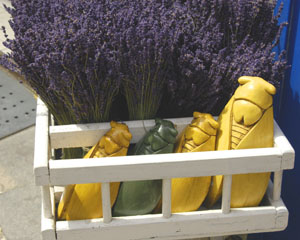
I am now back in Provence with sunshine, blue skies, warm temperatures and lavender. I arrived via:
The TGV
If I were to drive each time from Paris to Provence, from the door of ou apartment in Paris to the door of our home in Provence, it would take over 7 hours. I am lucky enough to be able to take the TGV, a high speed train, back and forth and the ride only takes three hours. The train goes all the way down to Marseilles with occasional stops in Avignon and has turned out to be so wildly popular that the French are now planning to do the same thing from Paris to Alsace up by Germany. And, of course, there is the Eurostar as well going from Paris to London via the chunnel.
I have been going back and forth and now that the newness has worn off it seems to take every single minute of the three hours to reach my destination. Luckily I love to read and pass many happy hours occupied by books. I usually have my laptop with me and do a little writing and wish there were some way to get online-wouldn’t that be a great way to pass the time. Occasionally, I will make my way to the dining car which is really more like a snack stand with very few stools screwed to the floor and it is often necessary to stand at a bar, much like in French cafes, and eat my sandwich or drink my diet coke. It isn’t a bar so you can’t while away the time sipping drinks although, this being France, you can have beer or wine.
There have been a few bad trips where there is a whining or screaming child in the car and there is usually an adult or two who talk very loudly. Once, during a very hot summer, the car I was in had a nonfunctioning air conditioner and it was like an iron box used for touture by evil Japanese army personnel in some POW camp. I really wanted to get a refund for my ticket as I spent most of the time in the dining car or sitting on the stairs out in the luggage area. Usually, the trains come with cars that are two levels, or duplex as they call it, and they are the newer ones, so there are stairs to sit on if you wish, which I did when my car was so oven-like. With the newer cars there is alot more space to store luggage, between cars, in an area in the middle of the car, and some can be squeezed behind most seats-this is where I usually store my cat in his carrier when he is with me. Although he howls and complains at first, by the time I get on the train he has become “catatonic”, pardon the pun, and is quiet for the whole trip.
On my last trip, the train was packed, this being June. There wasn’t a spare seat to be had and, to my dismay, as I neared my seat I got a look at my companion. She was a nice enough girl but she had a huge bag at her feet and an even larger golden retrever. I was supposed to take an aisle seat and she tried to squeeze her dog and her huge bag over in the one seat area. The bag and the dog both were well onto my side. For a brief moment I hoped to get another seat, and had even sat there, but someone came to claim it and I trudged back to my original place. She gave me the window seat which was much better and the dog sat in the aisle blocking access to anyone trying to get to the bathroom or dining car. Except for a few dirty looks, no one said anything, just tried to squeeze by or take a giant step over him. I love dogs but I wondered at this. The lady who checked our tickets didn’t say a word, so I guess it is standard although I thought all animals had to be in some sort of holder.
For some reason the clerks selling the tickets for the TGV can never tell you what kind of seat you will have. I assume they must change the train cars at will, adding more if there are many bookings. All I know is, no matter how I beg, I almost always end up in a family seat of four with a table in the middle and touching knees with a stranger. Sometimes I am also facing backwards to the direction the train is heading which really bothers me at first but after a while I forget about it. I always seem to get a window seat which is fine except when the sun comes pouring in and I have to pull down the shade in spite of the dirty looks my neighbors give me. The last time I was in a family seating, the lady directly across from me had a huge bag that she kept between her feet. It intruded into my space and it was an uncomfortable 3 hours. I don’t know why she didn’t put it with the luggage as there was plenty of room. I was by the window and a man was next to me who promptly fell asleep so I didn’t feel comfortable waking him up to get into the aisle to make a trip to the bathroom. My legs started aching and I longed to just stand up to stretch them but didn’t. It is great when I get on the train, walk down the aisle and find I am in a seat for two, unless the other occupant has a huge bag and dog. I used to always want a seat by the window, whether train or plane, but, unless I am with Maurice, I now want the aisle so I don’t have to bother my neighbor getting up and down.
The trains heading south in France from Paris originate at the Gare de Lyon Station, one of five huge train stations in Paris open to the air on one side with the trains waiting in rows to take their turn leaving. There is a fabulous restaurant here called le Train Bleu, full of painted walls and ceilings, wood and brass, and arched windows soaring to the ceiling with lovely lace curtains. It gives you a taste of what travel must have been like at the time when women wore hats and gloves and traveled with trunks and maids.
As the train leaves the station, we pass through the suburbs of Paris and are quickly into green countryside and are soon passing small villages and fields with herds of white cattle and an occasional castle. I always know when we are getting into Provence as the vegetation starts changing with parosol pines grouped on the horizon, the dirt taking on a yellow ochre tinge and vineyards everywhere. The stations newly built for the TGVs in Provence are new and modern with fantastic archetectural details and are mostly made of glass. Although the windows are tinted, it can be very bright inside the station and hot in the summer. The winter can be horrible as they have these little convection like ovens that put out a very small amount of hot air that does nothing to heat up the room, even if you are standing immediately next to it. The stations in Paris, because they are wide open at one side for access of the trains, are the same without any heaters that I can see to warm it up.
Despite all of my complaints, the TGV is the way to travel. There are no long security lines to go through, no sitting and waiting in some lounge in an airport. You just show up where you might have to wait a few minutes to see on a screen up above which quai the train is leaving from and go find your car. The worst part can be lugging your luggage down the quai looking for the car usually, as in Murphy’s law, being at the very end, and then struggling to get your luggage up the stairs and into the storage area-if it isn’t full. I am lucky enough that I now have everything I need duplicated on each end and only have to carry my computer case and, occasionally depending on the length of my stay, Elliot, my cat. What a great life I have dividing my time between Paris and Provence, and having a rapid way to get between them.
Fri 17 Jun 2005
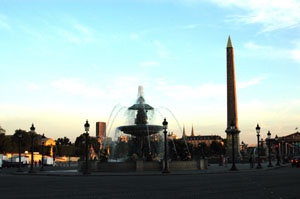
Place de la Concorde glowing in the setting sun.
Chapter Five
Throne-Less In France
I had no idea that toilets would become an issue with me in France. I think we are spoiled in America with the availability of toilets in any place we happen to be. Of course, even in America, when standing in a line of fifty women at the door of a public bathroom at a football stadium, or a concert hall, I always gripe that this must be another bathroom designed by a man with no thought to the time it takes for women to go to the bathroom. Three toilets is not enough for three thousand women to take care of business and get back to their seats in time for the beginning of the second act or half.
I know that finding a bathroom can be a difficult feat in large American cities such as New York City and I remember the time when I was standing in line to get tickets to a play when a lady with crutches came up to the window and begged to be allowed to use the restrooms at the theater. She was almost in tears as she told them it was an emergency, but her pleas did no good. The man had no intention of letting her in. I can’t tell you how many cokes I’ve bought that didn’t want or stores I’ve gone into that I didn’t really want to shop in, just to find a bathroom.
I remember a time years ago in England. I was in a café and asked where the restroom was. I got a blank look from the owner, even though she was an English speaker. I had to say bathroom with no result and finally, toilet, before she said, “Oh, you mean the loo!” At least the word toilet is understood in France.
In cafés and bistros in Paris the bathroom is almost always downstairs. I used to wander around looking for the toilet sign before learning this. Now, I just look for the banister that leads downstairs without having to use my bad French for the direction of “les toilettes”. Sometimes the proprietor will ask if you are a customer. I’m sure a lot of people sneak in and try to use the toilets without buying anything. I am often surprised when I go downstairs and, although the toilet itself may be behind a closed door, the men’s urinal is in plain sight, often right next to the sink. I hate getting downstairs and seeing the back of a man using the urinal. Who sets these bathrooms up?
McDonalds can be a good choice for a place that you can get into to use the toilet and not be noticed, as there are so many people there buying food. Nobody notices people sneaking by the counter heading for the restroom. Once I thought I would try this in an area of Paris that is not known to be posh and full of wealthy people. I opened stall door after stall door and not one of the toilets was usable. I don’t know if they couldn’t be flushed or hadn’t been flushed. Either way, I was out of there. I went to one of the toilets set up on the streets that requires you to pay .45 Euro for its use. Desperate times call for desperate measures and the toilets I have used like this have turned out to be clean. Of course when there are times when they are out of order, or the men who maintain them are on strike, then you consider using the little alleys that run along the sides of the walls in the metro.
One thing I have found interesting is the different ways to flush toilets. There is the gravity method where the toilet tank is high up on the wall and a handle attached to a chain is pulled, releasing the water to plunge down and flush. Then there is the little knob on the top of the toilet tank that you pull up. There is also, sometimes, something to push on some toilets where you can pick one of two button halves: the one with one water drop on it if you have only pee’d - you get just a short little burst of water with this button - or the second button half showing two water drops engraved on it, for when a whole flush is needed. I assume this is a way to conserve water.
There is a website called The Bathroom Diaries that actually lists the worst and best bathrooms around the world, giving the Golden Plunger Award to those that are fantastic. I’m sure that this site must be run by a woman, as only women seem concerned with something like the state of bathrooms. The top prize for this year went to a bathroom somewhere in New Zealand but the runner up was the fantastic public restroom by La Madeleine, the Greek-temple-looking cathedral near the Opera House in Paris. It is fabulous with dark wood, stained glass, brass and mirrors. The lady who keeps it all clean and running is called “Madame Pipi.”
All sorts of bathrooms and toilets can be found in France. A large number of them don’t have seats. What is this about? You can see the two holes for the toilet seat where it should be attached, but no seat. Someone said that they were told that it was considered unhygienic and difficult to clean, so it was left off. Left off or pulled off?
Apparently French women don’t sit down on toilet seats anyway. They hover. I know that a lot of American women (and I’m sure women worldwide) don’t sit either, at least not without a special paper toilet seat cover. I tried to get my husband’s five-year-old granddaughter to sit on a toilet and got a huge reaction, and she refused. I had to hold her and elevate her over the seat. So I assume French women don’t care if there isn’t a seat as they aren’t going to sit on it anyway. They are appalled by the doors on stalls in America because you can see the feet of the person using it. They like their stall doors touching the floor for complete privacy. It’s just one of those cultural things.
I once used a bathroom in a Monoprix store. Monoprix is the French equivalent to Walmart. I was glad Maurice was with me as the door was covered in French instructions. We had to pay to use it. It was very clean inside but strangely damp. I found out why: after I left, the door locked with a sound of airlocks closing like a submarine getting ready to dive, and loud sounds of water swishing around could be heard. The whole room from top to bottom was vibrating to its being cleaned under high pressure with a disinfectant. This was a new one on me.
No description of public “toilettes” in France would be complete without a mention of the dreaded Turkish Toilets. Unfortunately, they are found at almost every roadside stop and in many older places, and needless to say, I hate them. But the French like them as they are considered hygienic: there’s no wondering about who sat on a seat before you.
Basically, the Turkish Toilet is a hole in the ground with a place to put your feet on either side. I learned that you are supposed to not face the wall but turn around. As much as I loathe using these toilets, sometimes, I have no choice. And I feel lucky if there is even toilet paper available. No matter how I try, I just can’t keep my shoes from getting splattered. Someone suggested completely removing pants and underwear before using one of these Turkish Toilets to prevent splattering. I don’t think so. I have no idea what women with arthritis in their knees or hips do. I’m not in great shape myself, and can hardly squat there without my knees and thighs starting to ache, like one of those exercises to strengthen thigh muscles where you lean your back against the wall and bend your knees. After forty-five seconds or so you are feeling the burn, and are in agony. Sometimes I’ve had to put my hand on the wall or floor to keep from falling. How hygienic is that? I also learned to always step out of the square of this Turkish toilet before flushing. If you don’t, water will cover your shoes. Père LaChaise Cemetery has this type of toilet and I was tempted to use it until I went in and saw the mess left behind by someone with what I guess could be called explosive diarrhea. Sometimes I feel like I am in a third world country when I see something like this.
Men are lucky. The only time I have Penis Envy is when I really have to go, in Paris, and find myself having to use a public bathroom. Men can pee by going behind a tree, or stopping on the side of a road and facing away from the traffic. Anytime I have tried something “different” I always have a disaster that I won’t go into here. It’s just one more thing about France where I can say once more, “Who knew?”
Thu 16 Jun 2005
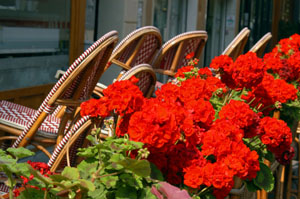
Red geraniums are seen everywhere in France during the summer.
Chapter Four
Foot-Less In France
In the States, I knew eating would be different in France when I asked Maurice if he wanted some French dressing on his salad and he asked me what that was. I showed him the bottle of the orange liquid I had in my refrigerator and he said, with a rather distressed look, “Why don’t you let me make the salad dressing?” True to a traditional vinaigrette, his dressing had Dijon mustard in it. It was a lovely muted yellow and tasted light and fresh.
So when we moved to Paris, I was slightly prepared for differences in food. I knew the shopping would be challenging and that many people bought their provisions at the colorful street markets that are found not only in Paris, but all over Europe. But my first experience at a market is the one I remember the most.
A trip to the market is a wonderful experience. It involves all of the senses. Your eyes can hardly take in all of the colors of the fruits and vegetables spread out and piled up - purple eggplants, gleaming, tomatoes lustrous and juicy, green zucchinis laid out in rows like soldiers or spread out like green fans, mountains of cherries just picked and succulent under their tight red-black skins. A whiff of the dirt still clinging to the potatoes whisks you to the country, as does the fresh scent of basil just cut and bundled into little bouquets. The vendors are calling out their specials to tempt you to stop, and sometimes hand out samples, such as a wedge of melon or a peach to show how fresh and tasty their wares are. You can touch a tomato or melon but it’s best to let the vendor pick out your selection so it is ripe and ready to eat when you get home.
On my first trip, we walked past bins of cheeses, white and yellow, soft and hard, some with blue lines running through them. There were huge rounds of cheese the diameter of a tire from which the cheese was cut into slices for customers crowding around. There were little round white cheeses from goat’s milk, the flatter, softer lozenges of Brie, and a hard cheese in a wonderful apricot-orange color. I haven’t had much experience in cheeses other than cheddar and that Ameri-cheese standby, Velveeta.
Maurice has introduced me to a whole new world of cheeses. Some of them are too strong to me, both in taste and smell. In fact, sometimes when I open the refrigerator and am assaulted by very strong smells my first instinct is to find out what has spoiled. Then I remember that Maurice has bought some cheese. It’s a gradual process, but I’ve come to love some cheeses that I’d never heard of before.
The first time I went grocery shopping with Maurice, we stood in front of the cheese section of the store for a very long time while he decided which cheese he wanted. It was a gourmet store in the States with cheeses from all over the world. I recognized the names Brie and Camembert and that was about all. He took longer to make his selection than I do to choose a dress. That’s when I realized how important cheese was to the French - at least this Frenchman. Let’s not even bring up the subject of choosing wines - that’s another chapter all by itself.
The first cheese I tried in Paris was actually on a salad - a “Salade Chèvre Chaude.” It’s a round slice of goat cheese on bread that is toasted under the grill then placed atop salad greens. The first few bites are an incredible blend of flavors, textures and temperatures. There is the soft warmth of the cheese, the crunch of the toast, the tart vinaigrette on the cool lettuce, sweet tomato and, if you are lucky, the slight bittersweet taste of crunchy walnuts.
I’ve tried an autumn cheese called “Arômes au Gene de Marc” smothered in dried grape seeds, and a cheese wrapped in chestnut tree leaves called “Banon (à la Feuille).” At a party I discovered Pyrennees cheese that is eaten with a small amount of black cherry jam. An unforgettable treat.
There is also a lady in the market who sells wobbly towers of boxes filled with fresh eggs. They are all brown and beige. I never see any white ones unless they are goose eggs, which are larger. I’ve discovered that the yolks are a much richer color than the eggs that I’ve had in the States. The first time my husband made an omelet, I thought he had added cheddar cheese to the eggs because the omelet was so rich and golden yellow.
I noticed there were different stands for each kind of meat. One place sells beef only, one pork. I can tell it is pork because there is the whole body of a pig turning in a rotisserie, head still attached and the little curled tail stiffly browning in front of the fire. There is also a seafood merchant where there are crabs so recently taken from the ocean that they are still moving. One place offers horsemeat. It looks dark red and low fat and the first time I saw it I mistook it for beef. On closer inspection I noticed a horse head done in brass above the stand and a sign saying “Chevalines.” I don’t see myself ever trying horsemeat, although I do wonder what it tastes like. But it doesn’t keep me awake at night.
We went to the stand selling poultry as we had decided on chicken for lunch. I noticed some tiny bodies sort of stretched out with what looks like perhaps the liver left in. I realized, in shock, that this was rabbit, something my husband loves, but which I just can’t make myself try yet. I have since found out that the kidneys are left in the rabbit to show that it is indeed a rabbit and not something else I don’t want to think about. We thought about buying a chicken already prepared. We saw them slowly rotating in a grill, with the skin turning golden and juice dripping down on potatoes underneath. The aroma floating out almost seduced us, but we had a new oven with a rotisserie at home that we were determined to try.
I looked into the case. There were some chickens but they all still had their heads and feet attached. I am used to chicken being cut into neat, handy pieces and packaged behind cellophane, unrecognisable as an animal. I asked my husband, “Do we have to take the chicken with the feet and head attached? I don’t think I can eat it that way.” I was thrilled to find out that the feet and head would be cut off by the friendly butcher, who said to my husband in French, “Didn’t you have a blond with you last week?” and then winked at me. He then took our chicken over to a table where a huge tank sat with an attached hose. After he whacked off the head and feet, he proceeded to light the end of the hose and when a flame shot out, he moved it slowly back and forth over the chicken, getting rid of any last feathers. When the strong smell of burnt feathers reached me, I wondered if this was too close up and personal; whether I would be able to even eat this bird.
We have a little cart on wheels with a handle that goes with us on all of our market trips. Into the cart went the chicken, along with our purchases of fruits and vegetables. At home, I crossed my fingers and introduced the chicken into our new rotisserie. Voila! It turned out to be marvelously juicy with crisp brown skin, just like the cooked chickens at the market. We rounded out our meal with fresh green beans simmered with tomato, shallots, and basil. This French-style feast included a bottle of white wine from Alsace and a finale of cheese from the Haute Savoie region. It doesn’t get any better than that.
Wed 15 Jun 2005
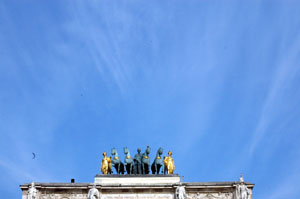
A spectacular sky above the minature arch leading into the Tuleries Garden.
Chapter Three
Class-Less In France
I decided that after six months had passed and I wasn’t fluent in French, as I was told I would be, that I should try a French class.
What a class it turned out to be. I wish I knew how to write a filmscript because I have such a “movie” from my experience in this class. Every single person in the class had a dramatic story and was a self-contained mini-series.
My French class took place in Paris, in an Institute for an Eastern European country where, I came to understand, a classroom was provided in return for teaching French to persons living in Paris. There was always at least one person from that country in the class while I was there. Sometimes we had as many as thirteen students in the class. There were never less than seven.
I had to take a long subway ride from our apartment to the Institute. It was near the Luxembourg Gardens, a very nice part of Paris. As time went by I came to spend many hours walking around the gardens, watching people, taking pictures. It’s a very restful place even with all of the joggers running around.
The first day I walked into the Institute I had to find my way down dark stairs, through a little auditorium filled with chairs, also in the dark, into a small, hot classroom. The room had no windows and the whole time I was in the class, no matter what the temperature outside, it was hot. A fan was finally purchased which added some much welcome relief. An Australian and I would plant ourselves in front of it dying in the heat, while the young nonmenapausal girls would shiver and pull on sweaters. There was a large rectangular wooden table in the center of the room surrounded by chairs that soon filled up.
The teacher rushed in. I was to find out that she always rushed. She appeared to be in her thirties, was attractive with blond hair, but wore no make-up and was dressed in a black dress with a silver pin on the collar. She had on what was stylish in Paris right then, patterned stockings in a grey and white animal skin pattern. With the quick, almost nervous movements of a bird, she opened cabinets, took out books and went through our registration papers. She introduced herself in French. Her name was Angela, and that was all I understood. She spoke nothing but French from the very beginning. We were to be introduced to the immersion method and she wouldn’t let us speak in our native language at all. We had to struggle with the little French we knew to answer any questions she might ask.
We took turns introducing ourselves in French and saying where we were from. There were no men in our class. Of the ten students there the first day, seven of us were married to Frenchmen. Besides being the only American, I was the oldest one there. The countries represented were Russia, Poland, Australia, the Philippines, Japan, Iran, Iraq, Columbia, Singapore, and Eastern Europe. I was surprised that so many of us were married to Frenchmen. I had to wonder if the men would be taking language classes if they were living in the country of their wives. But then, I was to find out that few men anywhere with serious careers opt to live in the country of their wives.
I once had a coffee cup that had a Far Side cartoon on it. In one picture a person was angry at a dog and was saying, “Bad dog, Ginger. Bad dog, Ginger. Shame on you, Ginger.” The second picture showed what Ginger, the dog, actually understood:”Blah, blah, blah, Ginger. Blah, blah, Ginger. Blah, blah, blah, Ginger.” I felt like Ginger.
Angela rattled off something in French. We looked at each other with incomprehension and I could tell the others felt like Ginger, too. The girl from the Philippines understood something Angela had said and when her neighbor turned to her and said, “What did she say?” Angela said, “French only!” Then Angela had the girl who asked the question repeat what she had asked in French. She did supply some French words when we came to a complete stop but we couldn’t look up any words in our French dictionaries. Angela said, “In this class, I am the dictionary.” Somehow I understood what she was saying.
We had a bad couple of days at the beginning. It was exhausting to keep focused and try to figure out what Angela was saying. The Australian lady, Victoria, started crying the first day because she felt so out of depth in the class. Afterwards she said, “I didn’t understand a single word she said in class. I think I’m going to quit!” She turned up the next day, though, and said her husband told her that even if she only got ten per cent of what was being said in class, that was good. She was going to try and stick it out.
When Angela wanted to get our attention as we took turns sitting there in a daze, it didn’t help that she would say, “Cuckoo!” This made Victoria cry again as she thought Angela was making fun of her. I think, although I am still not entirely sure, that this was just the French way of saying, “Yoo hoo!” I don’t believe that she was comparing us to an unintelligent bird but who knows?
By the end of the first week we had started to tentatively talk to each other before and after class. We did not speak in French. To my surprise, we were all speaking in English. I would soon find that this was not helping my French, but suddenly I was having a much better time in Paris. One girl’s husband said, “I sure hope you are speaking French with all of the other women after class.” If he only knew.
For the first time in my life, I found myself to be the most popular girl in the class. In my early school days I was quiet and shy and was always The Good One, never causing any trouble. I could easily be mortified by just about anything and that added to my quietness as I didn’t want to call any attention to myself. Fast forward these many years later and I discovered that I didn’t mind if I made mistakes, mistakes that often led to the others in the class laughing. I had no idea I could be so entertaining. I still don’t know if it was my American openness or just the fact that I truly didn’t care if I made mistakes or looked foolish.
I was helped along in my light-hearted approach by Victoria who had the same sense of humor. Victoria, the Australian, and I weren’t allowed to sit next to each other as we might speak in English so we sat across from each other (which was true). She had a wonderful infectious laugh and our eyes would meet across the table and she would laugh at me.
Fortunately, Angela also liked my sense of humor. She had a good one herself and occasionally, especially as time passed, we would understand something funny that she said. The first day, and many after that, I brought along a small plastic bottle of diet coke mainly because it was so hot in the classroom. I guess this must be a typical sign that someone is American, as I was often used as a metaphor for someone American with bottle of diet coke.
One day the subject of saints came up. Mary, the girl from the Philippines, did not understand what a saint was. Why, I don’t know. I thought the Philippines was mainly Catholic. As it all had to be explained in French we were struggling like mad to come up with the words to explain a saint - words like Catholic Church, angels, miracles. Mary still looked clueless so I threw in the name of Joan of Arc. I thought everyone had heard of her. No, not Mary. Angela drew a very bad drawing of a stick figure in front of a pole and a fire beneath her. With that drawing I wasn’t surprised when Mary still looked puzzled. I had just learned the word for toast, pain grille, so I told Mary that Joan of Arc was turned into pain grillee. Victoria, Angela and I got hysterical, laughing until tears came to our eyes. Angela said I was “morbide,” the French word for sick, I guess. The rest of the class looked at us like we were crazy, if not a little weird. Angela finally told Mary to go home and ask her husband to explain.
Victoria turned out to be our social director, so to speak. She was very good at getting us together for coffee or lunch after class and this was when a small group of us developed a very close relationship. I thought that this must happen in most French classes but was told from others who had taken other classes that this wasn’t the case. What we developed was very unusual. I think part of our bonding was the fact that we were all isolated by our lack of French and had a lot of experiences in common. We had so much to talk about. Unfortunately, we didn’t do it in French.
I stopped taking the class after a long trip to the States. I’m sure it helped my French some, but I have not become fluent and am still French-less. What I miss most is the girls from the class. Our lives took us all in separate directions and I don’t see them any more. I have some of their phone numbers and want to organize a big party for all of us. Someday. Oh, and it will all be in English, of course.
— Next Page »